
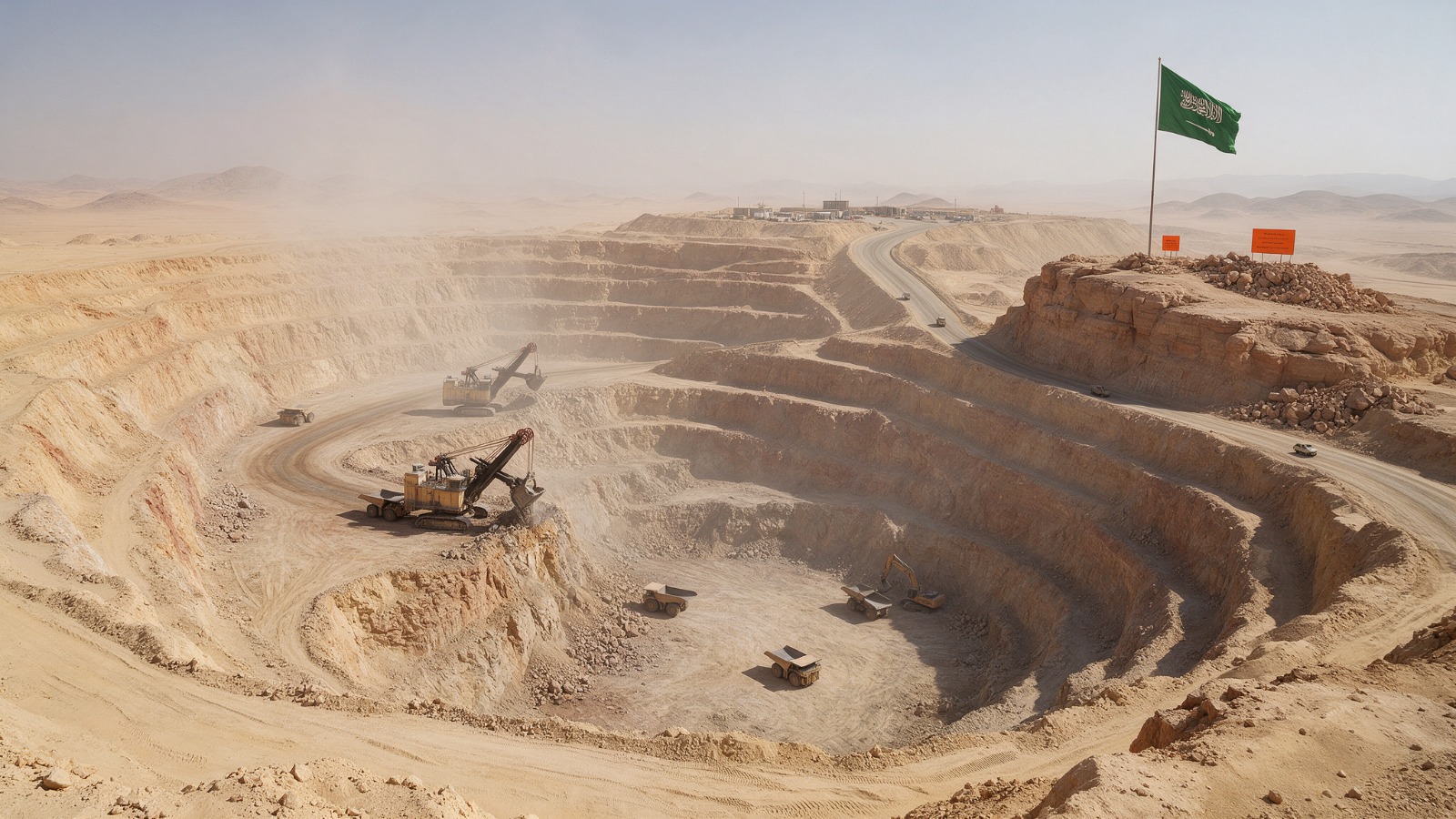
Saudi Arabia is rapidly expanding its mining economy, creating new opportunities for exploration companies, mine operators, contractors, and international investors. But entering the sector requires more than identifying a promising mineral opportunity. Investors need the right Saudi entity, the correct mining authorization, and a clear plan for technical, financial, environmental, and operational compliance.
1. Why Saudi Arabia’s Mining Sector Is Attracting Investors
Mining has become a major part of Saudi Arabia’s economic diversification strategy. Arab News reported that mining investments reached SAR 44 billion in 2025, based on Ministry of Industry and Mineral Resources figures, while exploration spending increased 110 percent year on year.
For businesses considering Saudi market entry, opportunities extend across exploration, mineral extraction, processing, supporting services, and related infrastructure. Recent licensing rounds have also attracted Saudi and international companies competing for mineral areas containing gold, silver, copper, nickel, and zinc.
The commercial opportunity is significant, but licensing should be approached as part of a wider market-entry strategy rather than as a standalone permit.
2. Understand the Main Mining License Types
Saudi Arabia’s Taadeen platform lists several mining-related license categories. Within the broader Saudi business licensing framework, the correct authorization depends on the mineral, project stage, site, and intended activity.
A reconnaissance license supports preliminary investigation of targeted minerals and sample collection. An exploration license allows more detailed investigation through methods including surface work and geophysical or geochemical analysis.
For commercial extraction, a mining license permits companies to mine and exploit specified Class A and B minerals. Saudi Arabia also provides small mining licenses and building materials quarry licenses for relevant mineral categories. A general-purpose license can support facilities or land required outside the area of an existing mining or small-mine license.
Investors should therefore define the project scope before applying rather than treating a mining license as one universal authorization.
3. What Foreign Investors Need Before Applying
Foreign mining investors must establish the legal basis to operate in Saudi Arabia. Under the updated Investment Law, foreign investors register with the Ministry of Investment before engaging in investment activities. Following investment registration, they can proceed with Commercial Registration and obtain the approvals required from the relevant sector authorities.
This makes Saudi company registration an important part of the mining setup process. The Saudi entity and its registered activities should align with the mining activity being pursued.
Taadeen states, for example, that an exploration-license applicant must be a company with mining activity recorded in its Commercial Registration. Commercial mining licenses are also intended for companies.
4. What a Mining License Application Requires
A commercial mining project requires more than corporate documentation. The licensing framework examines whether the applicant can demonstrate that the proposed operation is technically, financially, environmentally, and commercially viable.
For a mining license, the application site must fall within a valid exploration-license area. Applicants must also provide an economic feasibility study, evidence of technical competence and financial capability, an environmental and social impact management plan, a rehabilitation and closure plan, and a financial guarantee.
These requirements mean investors should prepare their corporate structure, technical studies, funding evidence, environmental documentation, and operating plan together. Addressing them as connected workstreams can help reduce gaps between company establishment and sector licensing.
5. From Exploration to Commercial Mining
Exploration and commercial exploitation are distinct stages. An exploration license gives a company the right to investigate specified minerals within an approved area, while a mining license provides commercial exploitation rights for eligible minerals.
Taadeen currently lists an exploration-license duration of five years and a mining-license duration of 30 years. A mining license also permits the holder to transfer and sell exploited minerals, subject to the applicable license conditions and regulations.
For investors planning Saudi Arabia business expansion, this distinction matters. The entity structure, funding plan, technical program, and compliance preparations should reflect whether the business is still evaluating mineral potential or preparing for commercial production.
Moving into production requires a deeper level of feasibility, environmental, rehabilitation, and financial planning.
6. Compliance Continues After the License Is Issued
Receiving a mining license is not the end of the compliance process. Operators must continue meeting the conditions attached to their authorization as well as their wider Saudi business obligations.
Depending on the company’s structure, workforce, and activities, ongoing requirements may include tax and accounting compliance, employee onboarding, social insurance registrations, immigration processes, payroll administration, and Saudization compliance.
Mining operators must also continue following approved environmental and social obligations and maintain the rehabilitation and closure arrangements required for their project.
Planning these requirements before operations begin helps keep the company’s corporate, workforce, financial, and mining obligations aligned as the project develops.
Build Your Saudi Mining Operation with Al Taasis
Mining investment brings together sector licensing, company establishment, investment registration, government processes, banking, workforce requirements, and ongoing compliance.
Al Taasis supports businesses navigating business setup in Saudi Arabia, including corporate structuring, investment registration, Commercial Registration, licensing coordination, government-related services, banking assistance, and employee management.
If you are considering entering Saudi Arabia’s mining sector, Al Taasis can help structure your establishment around your proposed activity and operating model. Speak with our team to assess the corporate, licensing, and operational steps required to establish your Saudi presence.

Subscribe to Our Newsletter!
Enter your email to receive our monthly newsletter.